
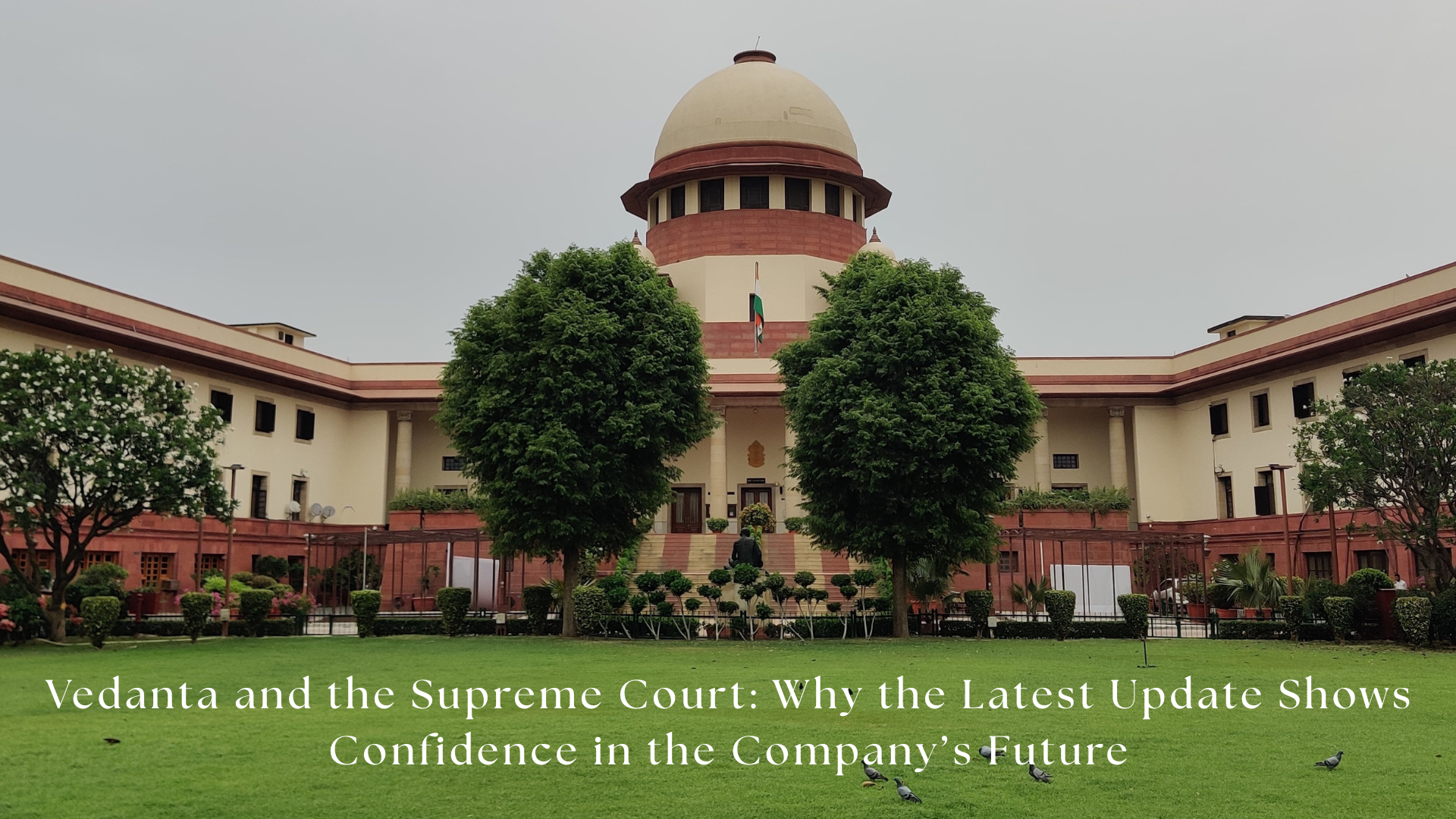
Vedanta Limited, one of India’s leading natural resource companies, has come into the limelight after the Supreme Court of India refused to take up a petition filed against Vedanta based on allegations made by the US-based short-seller Viceroy Research. A petition had been filed against Vedanta, asking regulators such as the Securities and Exchange Board of India (SEBI) and the Ministry of Corporate Affairs to investigate Vedanta and its group companies for alleged financial misconduct, including unauthorised transfers, weak governance, and under-investment.
However, in the Vedanta Supreme Court, the court declined to admit the Public Interest Litigation (PIL) for now. It said it would not go into the merits at this stage. The case, which came before a bench of Justices P.S. Narasimha and A.S. Chandurkar, was dismissed. Before the Supreme Court’s final verdict, two other Supreme Court judges had also recused themselves from the case, including a bench led by Chief Justice Gavai, along with Justice Chandrachud and Justice Chandran.
Why This Outcome is Encouraging for Vedanta
1. No Immediate Judgment of Wrongdoing
The court’s refusal to proceed clearly indicates that there is no judicial finding of guilt. The process is still open and structured, not rushed. That gives Vedanta enough space to present its position and continue its operations without an immediate cloud of legal judgment.
2. Confidence in Legal Process
The decision signals that India’s highest court demands proper procedure and evidence before escalating a case. The court clearly mentioned that it cannot be taken for granted that claims by a short-seller amount to automatic investigations.
3. Reduced Uncertainty for Stakeholders
For employees, investors, partners and communities associated with Vedanta, this outcome brings relief.
Vedanta Denies all Allegations
Vedanta, since the beginning, have been consistently denying all the allegations from Viceroy Research, calling them “malicious combinations of selective misinformation”. Rather than getting hampered by such baseless discussions, Vedanta has continued its focus on environmental, social and governance (ESG) responsibilities — improving operations, processes, and transparency over the years. The court’s decision gives Vedanta a platform to continue these efforts without unhelpful disruption.
Even in this matter, the Supreme Court refused to entertain the PIL, stating that regulatory review and disclosure must be verified, and false allegations will not be considered. Even the court further stated that “Why are companies outside India so concerned about how we conduct our affairs and under what law?” This signals that foreign-based short-sellers don’t have the right to interfere with judicial intervention in India.
Former CJI’ Chandrachud’s Involvement in the Case
The involvement of former Chief Justice DY Chandrachud added a crucial layer in the Vedanta Supreme Court case. With a distinguished track record of objective interpretation and judicial integrity, Chandrachud shared his opinion in the Viceroy report. He highlighted that such allegations affecting a major corporation must not be accepted at face value.
Unverified claims can be mainly used to tarnish a firm’s global reputation, create panic among the employees, and create unnecessary uncertainty among global investors. According to Chandrachud, the report did not provide enough proof to support the major accusations it made.
How Vedanta Supreme Court Decision Matters?
In the Vedanta case, the Supreme Court’s decision in its favour is a positive indicator and brings much relief to Vedanta and others.
For Vedanta: The court’s rejection of the PIL request is a win-win situation for Vedanta. Now the company can move ahead with its business and improvement plans while the matter remains in legal consideration, rather than in crisis mode.
For Market: Stakeholders may view this as a positive sign — legal stability is important in heavy industry and resource sectors.
For Reputation: Even in this challenging phase related to false Vedanta scam discussions, Vedanta demonstrates its willingness to engage with the system, face allegations, and maintain business continuity.
Conclusion
Indeed, Vedanta has come through the latest court stage as it can operate intact and its reputation largely intact. Vedanta Supreme Court decision highlighted that the court won’t rush to action based on unverified claims. Vedanta now has the time and space to manage the situation and continue doing what matters: operations, growth, sustainability and stakeholder value.
For anyone watching the situation, this is a positive signal: the company is being treated fairly and given a chance to respond with integrity and transparency.