
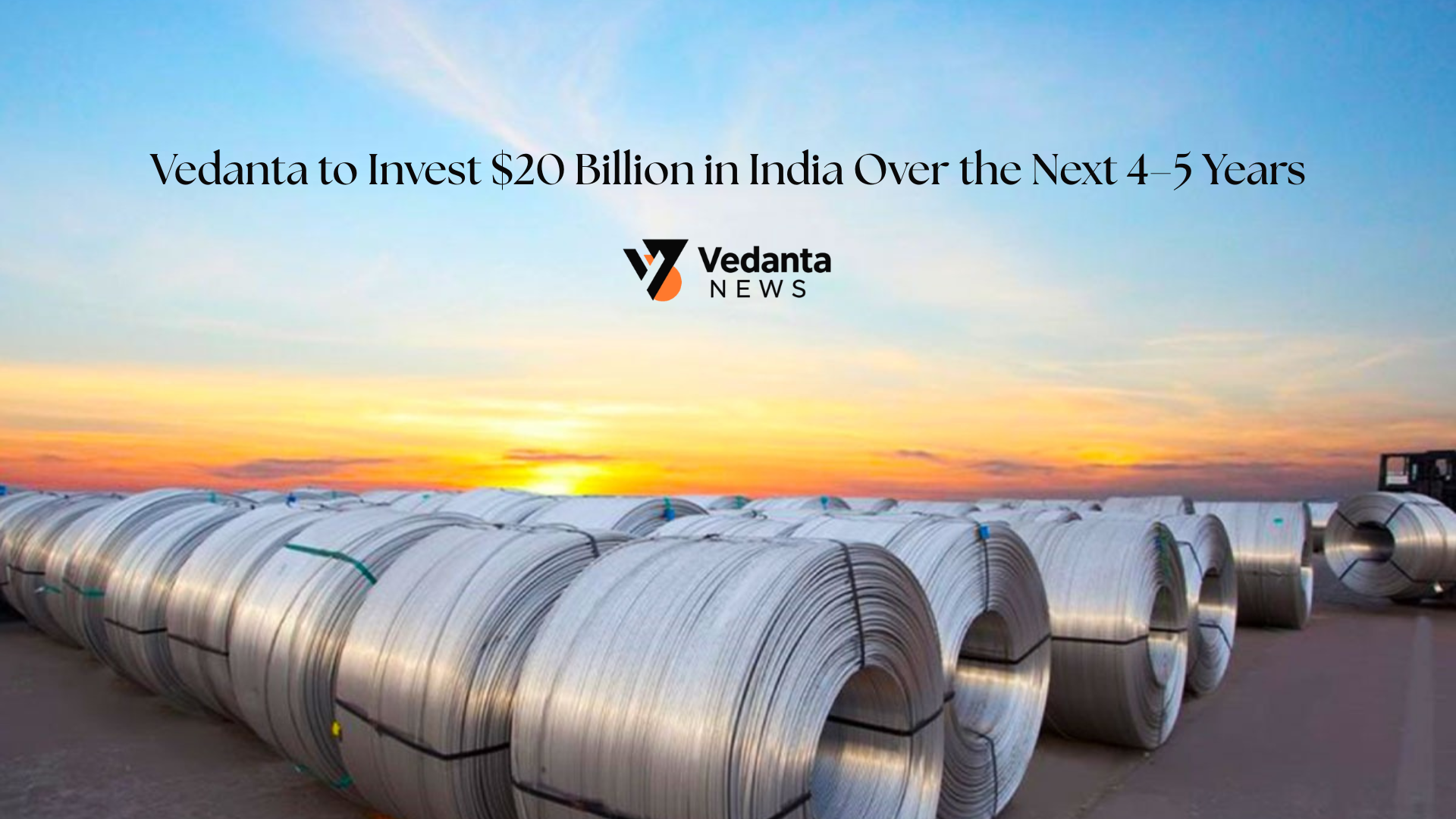
Vedanta Limited, one of the country’s largest natural resources and metals conglomerates, has announced plans to invest USD 20 billion in India in the next four to five years. This strategic move came soon after the National Company Law Tribunal (NCLT) approved Vedanta’s demerger plan, reflecting its confidence in the country’s growth trajectory and its vision to expand across sectors.
Vedanta, post the regulatory approval, will create four new entities, including Vedanta Aluminium, Vedanta Oil & Gas, Vedanta Power, and Vedanta Iron & Steel, while Vedanta Ltd. will retain the group’s stake in Hindustan Zinc and serve as an incubator for new and emerging businesses.
Vedanta to Expand its Multiple Businesses
According to Vedanta Chairman Anil Agarwal, the USD 20 billion will be invested across the company’s key business verticals. This expansion will further make the company more competitive.
As per the expansion plan:
- Vedanta will invest USD 4 billion each in its oil & gas and aluminium business. The amount will be utilized for capacity enhancements, particularly in the aluminium sector.
- The company will spend another USD 2 billion in the zinc and silver businesses. Through this, it will boost its capacities and overall output.
- Vedanta will further invest to support growth in iron ore and steel businesses, aligning with broader industrial expansion goals.
Aluminium and zinc already represent over 80% of Vedanta’s consolidated earnings before interest, tax, depreciation, and amortisation (EBITDA). This clearly indicates why these sectors remain crucial for expansion and growth.
Driving Capacity and Output Growth
The planned investments come soon after the demerger of Vedanta, which was approved by NCLT. The company will increase the production capacity in various sectors, with aluminium and zinc remaining at the forefront. Moreover, Vedanta will also raise silver production four times to 3,000 tonnes. However, further details related to the same are kept official.
While within the oil and gas segment, the company outlined targets that include a near-term output of 300,000–500,000 barrels per day from onshore, offshore, and northeast fields, with the potential to scale up to one million barrels per day in the longer term.
Such arrangements can be harmonised with the goals of India to enhance the production of vital resources in the country, mitigate the reliance on imports, and assist in energy security. Vedanta is already contributing largely to the economic growth of the country and is among the top-paying companies in terms of taxes.
These plans align with India’s objectives to strengthen domestic production of critical resources, reduce import dependence, and support energy security. Vedanta is already making significant contributions to the nation’s economic growth and is one of the highest tax-paying companies. For FY 2024-25, Vedanta tax worth INR 55,349 crore was paid by the company in the form of public exchequer, which includes both direct taxes, indirect taxes, including Vedanta GST payments, royalties, duties, and other statutory levies.
Funding, Debt and Financial Strategy
The media sources have indicated that out of the planned USD 20 billion investment, half of the amount will be financed via internal accruals; while the remaining amount will be arranged through equity partnerships or corporate borrowing.
Vedanta, at this point, follows a well-balanced strategy, which includes using internal funds and external borrowing. The company focusses on achieving long-term goals through a combination of various strategies. Despite being wrongly involved in Vedanta tax evasion talks, the company continued making significant contributions in nation’s overall growth.
How Vedanta’s $20 Billion Investment Will Help?
Vedanta’s USD 20 billion investment announcement sends a clear signal about its belief in India’s industrial growth potential. By distributing capital across multiple business verticals and focusing on capacity enhancement, the company is positioning itself to play a significant role in serving both domestic demand and export markets.
For policymakers, businesses, and investors, such commitments reflect confidence in the country’s economic environment and the long-term viability of industrial growth pathways.
Conclusion
Vedanta’s strategic agenda is to increase its production capacity, improve its leadership, and expand into new sectors within the next few years. The investment roadmap is backed by large-scale investments in oil and gas, aluminium, zinc, silver and steel sectors, which support both economic and sustainable development.
Indeed, Vedanta is contributing immensely to national growth while supporting local economies through its Vedanta tax contribution and further with its recent expansion plans.