
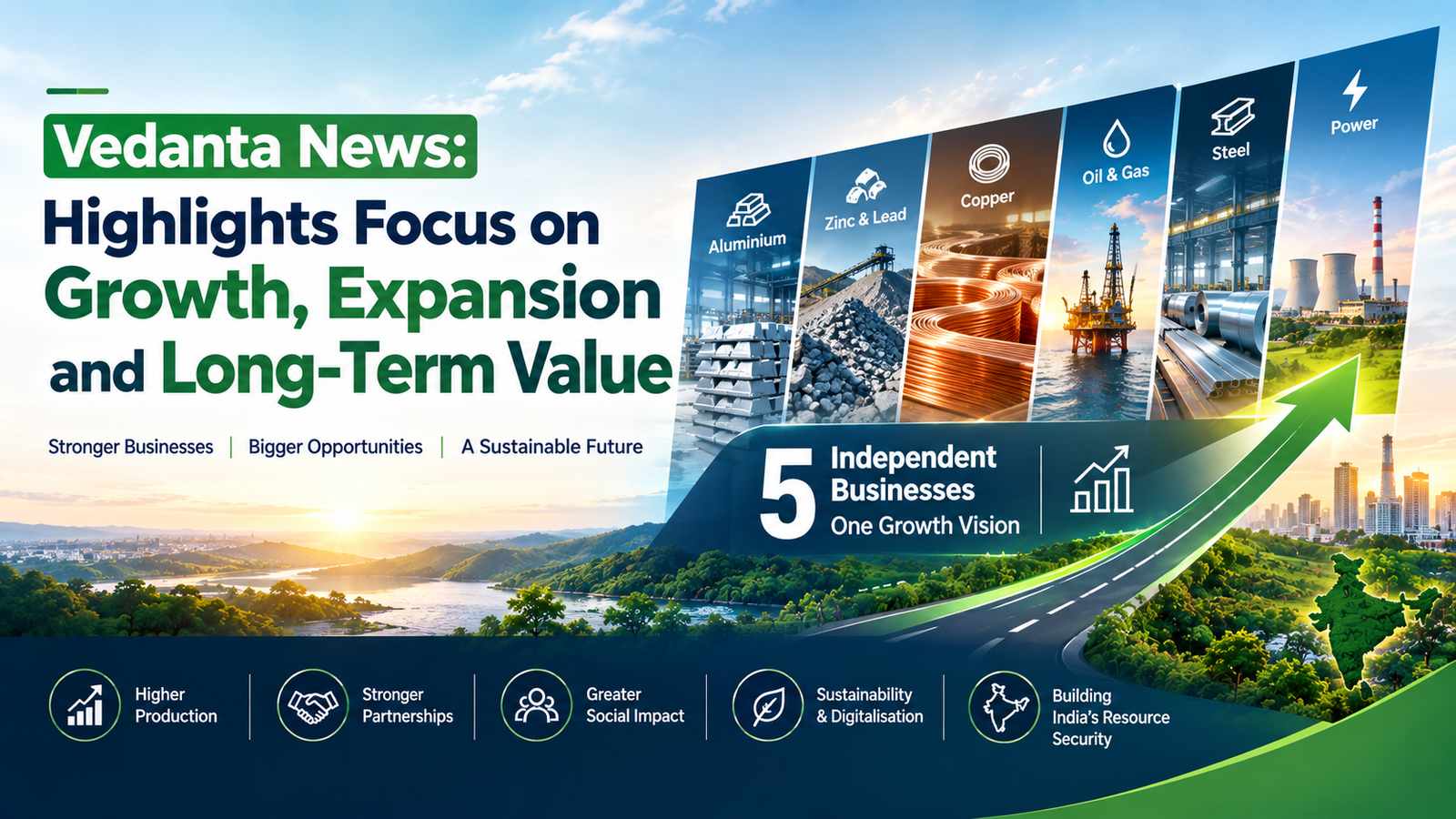
The discussion around Vedanta Viceroy has largely centred on past allegations and market speculation. However, Vedanta Limited’s 61st Annual General Meeting (AGM) has shifted the focus towards the company’s long-term strategy – expansion, operational growth, and value creation post its demerger.
While addressing the 61st annual general meeting, Vedanta’s Chairman – Anil Agarwal outlined an ambitious roadmap for the company’s newly demerged businesses. The corporate restructuring highlights the company’s plans to expand production across metals, oil & gas, steel, and power while strengthening India’s resource security. The group’s strategy would be centred around three priorities — producing more, building stronger partnerships and pursuing a wider social purpose.
Five Independent Businesses, One Growth Vision
Post the successful completion of the Vedanta demerger, the metals and mining company now operates through five independent businesses:
- Vedanta Limited
- Vedanta Aluminium
- Vedanta Oil & Gas
- Vedanta Iron & Steel
- Vedanta Power
As mentioned by Anil Agarwal, each of the newly established businesses has the potential to become a USD 100 billion company due to focused leadership and independent growth strategies.
Expansion Across Natural Resources
During the annual AGM, Anil Agarwal highlighted the company’s aggressive expansion plans, including;
- Vedanta plans to increase zinc and lead production to 3 million tonnes by 2031.
- Silver production will be doubled to 1,500 tonnes.
- Expand copper production to 1 million tonnes by the end of the decade.
- Increase ferro chrome capacity to 500,000 tonnes by FY2028.
- Expand nickel production to 60,000 tonnes.
Apart from these, Vedanta is also boosting its presence in critical minerals by exploration across 10 strategic mineral blocks. The move will help India meet the domestic demand of electric vehicles, renewable energy, electronics, and defence manufacturing.
Aluminium, Oil & Gas and Power Expansion– a Key Part of Vedanta Demerger
Vedanta Aluminium plans to double its production capacity to 6 million tonnes, while maintaining its position as one of the world’s lowest-cost aluminium producers. The oil & gas business has announced a USD 5 billion investment. The amount will be used to boost production fivefold to 500,000 barrels of oil equivalent per day.
Meanwhile, Vedanta Power aims to expand its generation capacity to 20,000 MW while exploring opportunities in nuclear energy.
The company’s iron and steel business also targets significant capacity expansion with a growing focus on green steel and speciality steel to meet future industrial demand.
Strong Financial Performance Supports Future Investments
Vedanta’s expansion strategy is backed by a record FY2026 financial performance.
The company reported:
- Revenue of ₹1.74 lakh crore.
- Profit after tax of ₹25,096 crore.
- EBITDA of ₹55,976 crore.
- Net Debt-to-EBITDA ratio of 0.95x, its strongest position in 14 quarters
These financial milestones provide improved flexibility to invest in the company’s long-term growth plans, strengthen the balance sheet, and speed up the expansion across the newly demerged businesses. Vedanta also plans to leverage artificial intelligence and digital technologies for improving operational efficiency, safety, productivity, and sustainability across its operations.
Besides Vedanta, other mining and metals companies across the world are increasingly using automation, data analytics and artificial intelligence for improving asset utilisation and manage complex operations.
The success of Vedanta’s expansion strategy will depend on the execution of large capital expenditure plans, commodity prices, regulatory approvals, access to mineral resources and the ability of the demerged companies to operate independently at scale.
Looking Beyond the Vedanta Viceroy Narrative
Though discussions around Vedanta Viceroy caught significant attention last year, the company’s AGM reflected a different focus – capacity expansion, stronger balance sheets, technology adoption, and nation-building through domestic resource development.
Vedanta also reaffirmed its commitment to sustainability, digital transformation, and social impact through initiatives such as Nand Ghar, alongside continued investments in critical minerals and energy security.
Vedanta’s Nand Ghar now covers 15,000 modernised anganwadi centres located across 17 states, supporting women and children through education, nutrition, healthcare, and skill development.
Conclusion
The latest AGM indicates that it’s time to look beyond the Vedanta Viceroy report and Vedanta debt and focus on the company’s execution and long-term growth plans.
With ambitious expansion plans across aluminium, zinc, copper, oil & gas, steel, power, and critical minerals, the company is positioning its newly demerged businesses to support India’s industrial ambitions while creating long-term value for stakeholders.