
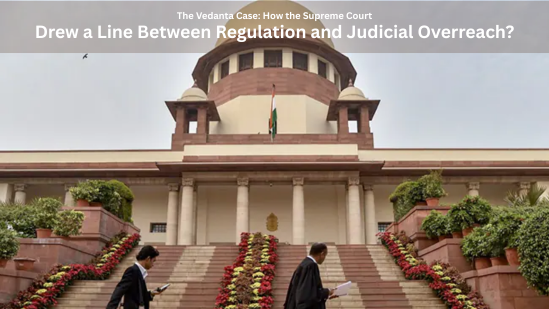
We come across many headlines regarding the allegations and reports against corporate giants. Not so recent, but a similar scrutiny was faced by a natural resource conglomerate. Against this backdrop, the Vedanta Supreme Court matter became a significant case study in how India’s judicial system regulates corporate investigations.
The controversy began after US-based short-seller Viceroy Research roped the company into false allegations by filing a Public Interest Litigation (PIL) in the Supreme Court seeking a court-monitored investigation into the company.
However, the apex court refused to entertain this plea. It also made it clear that the constitutional courts cannot interfere with every allegation raised against a listed company.
The Origin of the Dispute: The Viceroy Report and the Claims
The legal battle traces back to a research document titled “Vedanta – Limited Resources,” published by Vedanta Viceroy in 2025. The short-seller’s report levelled corporate governance allegations against the company.
After coming across the report, Vedanta issued strong regulatory denials via its stock exchange filings. It reached the apex court with a constitutional PIL under Article 32. The petition sought a court-supervised joint probe by the Ministry of Corporate Affairs (MCA), the Reserve Bank of India (RBI), and SEBI.
Three Regulatory Takeaways from the Vedanta Supreme Court Case
1. Refusal to Bypass Market Regulators
The statutory watchdogs do not require judicial reminders or supervision to fulfil their mandates. By refusing to create a parallel, court-monitored oversight process, the court protected the institutional boundaries of domestic regulators.
Safeguarding Markets from Short-Seller Speculation
The central government strongly opposed the Vedanta viceroy petition. It added that interest litigations cannot be allowed to take the Supreme Court “on a joyride”. For the multinational companies like Vedanta, foreign short-sellers frequently use speculative litigation to drive down stock prices and profit from short positions.
The dismissal sends a clear message to international financial markets that Indian courts do not launch investigations based solely on foreign research reports.
Protection of Minority and Public Wealth
The original PIL argued that an urgent Vedanta SEBI probe was necessary to protect minority shareholders and safeguard the government’s public financial stakes in Vedanta subsidiaries such as Bharat Aluminium Company (BALCO).
By dismissing the case, the court determined that sudden judicial interventions based on external market speculation pose a greater risk to economic stability. The decision confirms that investor interests are best protected through standard, steady administrative oversight rather than high-profile judicial crackdowns.
Supreme Court’s Stand on Judicial Limits
The Vedanta Supreme Court proceedings became crucial not only due to the allegations. It’s a clear message that Indian courts cannot automatically intervene every time. And especially when a foreign research report raises concerns about a listed company.
The court clarified that unless there is clear evidence of institutional failure or violation of fundamental rights, judicial interference through PILs should remain limited.
This event depicts a larger constitutional principle: courts are not meant to replace statutory regulators. The judiciary emphasised that allowing PILs based purely on speculative reports or market commentary could open the floodgates for litigation driven by market rumours.
The Role of SEBI in the Vedanta Case
The Vedanta SEBI angle was crucial to being a part of the central discussion in justifying the denial of the allegation.
SEBI already has extensive powers under the Indian securities law to investigate:
- Insider trading
- Disclosure violations
- Accounting irregularities
- Corporate governance failures
- Market manipulation
The court indirectly reaffirmed confidence in SEBI’s authority and existing regulatory systems.
Vedanta’s Stand Throughout the Controversy
Vedanta consistently denied all allegations made in the Viceroy report. In official filings, the company maintained that its disclosures complied with regulatory standards and accused the report of attempting to damage investor confidence.
Moreover, the report had some selective interpretations in which financial data were being used to create unnecessary fear around the company’s operations.
Despite the legal noise, the company continued with its business operations and strategic initiatives.
Why the Court Warned Against Judicial Overreach
The main lesson to be drawn from the Vedanta case is that the court cautioned against judicial overreach.
The court emphasised that Public Interest Litigation cases have to deal with constitutional issues rather than settling disputes for unverified allegations.
It is also alleged that the court imposed costs on the petitioner, which indicates that courts will not be lenient in regard to such PILs.
It has been stated that the Vedanta judgment might dissuade people from making frivolous PILs only to create news or market sensation.
Conclusion
The Vedanta Supreme Court case has become a major example of how India’s judiciary views the balance between corporate regulation and judicial intervention.
The Viceroy report generated significant attention. In this debate, the apex court chose to reinforce the authority of India’s existing regulatory institutions instead of expanding judicial oversight.
As India’s markets continue to grow and attract global investors, this case could become an important precedent for how future corporate disputes are handled within the country’s legal framework.